Contact Form

Name

Email *

Message *

Monday, July 27, 2020

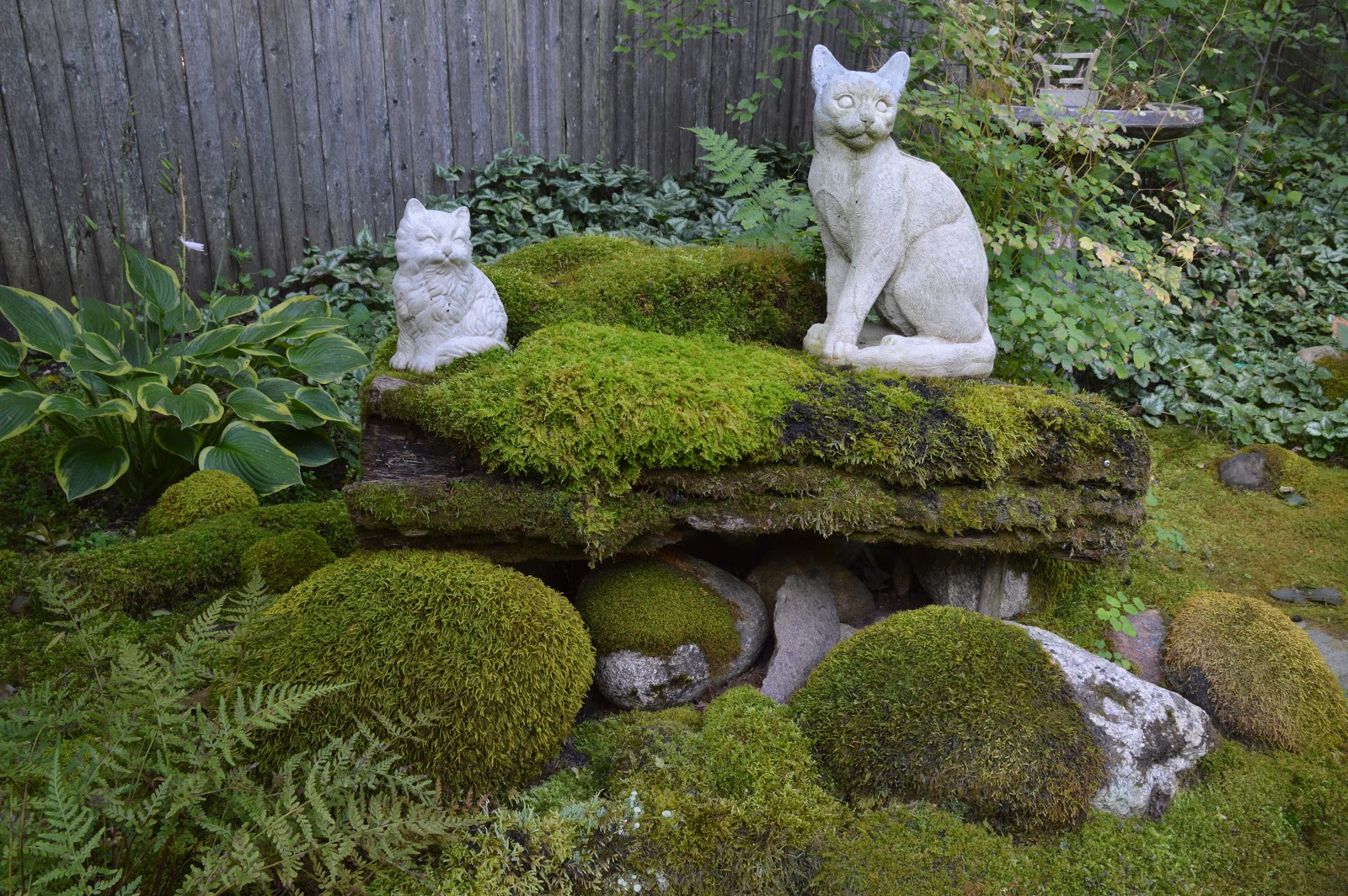
My wife loved cats.

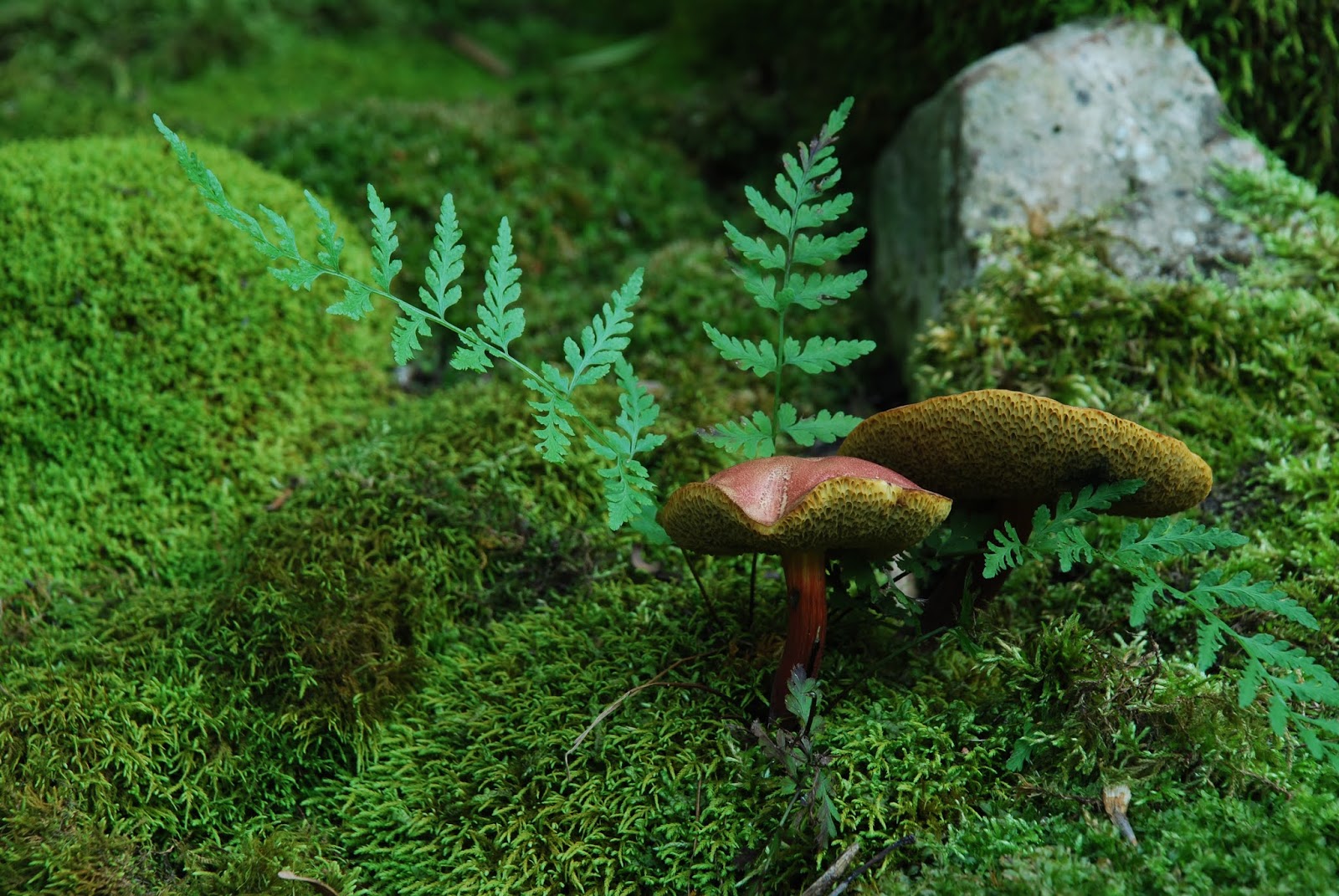
   My dear wife, gone now three years (cancer), "planted" numerous cats (and other creatures) around my gardens to "help" me.  And, honestly, she often did as these photos of a cat or two will show.  The photos were taken between 2015 and 2020, though the spot is about 10-12 years old.  It all started with a thick piece of a log left over from another project in another part of the gardens.  Most of the moss appeared on its own.  I think it did a great job.  There are about five species of moss in the garden.  The small fern is Cystopteris fragilis (Fragile fern or Brittle bladderfern), a world-wide fern which spreads readily by spores and rhizomes.  The sixth photo shows a closeup of the dominant moss, Thuidium delicatulum and Thalictrum dioicum (Early meadow rue), a small native perennial that appears often in my gardens
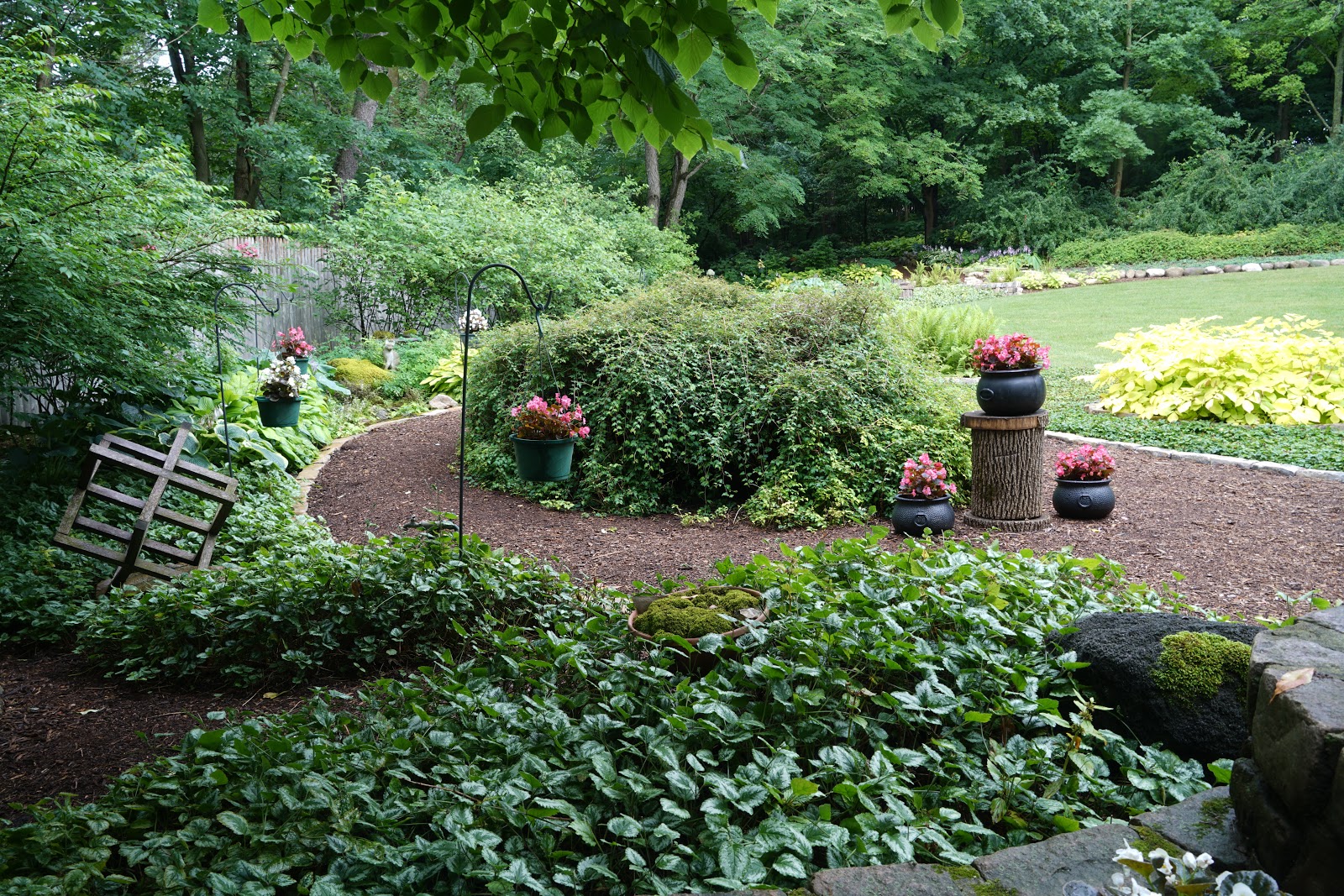
   The first two photos were taken a few weeks ago, and it shows the approach to the "cat garden" that is positioned on the south border of the property, backed up by a stockade fence (replaced in May).


Thursday, July 16, 2020

More of the back yard

   One of the most influential gardens I ever visited was Bellingrath Gardens, just south of Mobile, Alabama.  It has a large oval "great lawn" surrounded by shrubbery, backed up by large trees.  Both my front and back lawns reflect that design.  Quite unnatural--but striking and impactful.
   The first two photos, taken from the same location, show the before and after views of my remaking of the backyard last summer, and continuing this summer.  I reduced the size of the lawn by a third and added perennial beds around the smaller lawn.  In the second photo the Vinca minor has yet to fill in the foreground area.  The triangular bed on the left foreground was built last week, and it contains all tiny hostas.  
   The next two photos are views of the patio looking towards the house.  I only use begonias for annuals, and only one color, rose, plus white.  I gave up mixing colors and species many years ago.  I found it too busy and messy looking--like trying to look good wearing plaid pants and striped shirts.
   I designed the hanging light fixture way back in 1980, and I have three new fixtures in my gardens now.
   The next two photos show my favorite moss garden, built in 2016.  The wooden structure was designed by Leonardo da Vinci about 500 years ago.  I saw a larger version of it in a da Vinci museum in Venice, Italy.  I'll bet he never built one!  Very difficult to make, even with modern tools.
   The last photo is of one of the first moss gardens I built, around 2008.  Moss Acres, a commercial seller of moss in Pennsylvania, uses this photo in their magazine ads and on their Facebook page.


Friday, July 3, 2020


The Williamsburg Garden

   This garden is adjacent to the patio, to its north.  Its name, and the garden itself, was inspired by my trip to Williamsburg, where I was impressed by the formal gardens there, often including antique paving bricks.  I began the garden in the late 1970s, and it has changed considerably over the years.  In 1999 I leveled it by digging down a foot on the north end.  About 15 years ago I added brick walls on the west and north sides.  This year I am rebuilding them, and I will add a cedar top to the walls, the four "pedestals," and the center cylinder which was built to cover the well casing.  I will also remove the boxwoods on the north side, replacing them with a low perennial that will not block the view of the bricks (what was I thinking when I planted boxwoods there, anyway?).
   Because it was getting increasingly difficult to grow grass in the shade there, I replaced the grass in 2017 with moss.  The species is Climacium americanum, a moderately common moss found in eastern North America.  It is especially beautiful when the new growth (yellow green color), in a hydrated state, is backlighted by a low-angle sun--shown in the last two photos.
   The Japanese garden is visible to the north of the garden.
   The flowers are wax begonias.


Tuesday, June 9, 2020

Continuing the tour--into the back yard

Note 1: This is the fourth installment of a "tour" of my gardens, the first appearing on April 1st, prefaced by garden maps on March 9th.

Note 2: I will not have another post until early July, as I will be touring in Utah.

   The first photo, of course, is the same as the photo on my home page.  The view is from the upper patio which is just west of the house, and it looks to the southwest.  The fence (just replaced a month ago) is on the south lot line.  
   The view of the next photo is directly west, and it shows the woods which is on the west lot line.  The view of the next photo is to the northwest.  The area in the right side of the photo (screened somewhat by shrubs) with red begonias is the Williamsburg Garden.  It will be shown in another blog.  Finally, beyond that garden is a partial view of my Japanese-style garden, which will be the last in the series of blogs on my "tour."
   The red bricks in the patio are reclaimed street pavers installed in streets of Milwaukee in the early 1900s.  I collected them in 1973 when the street was torn out and repaved.
   The curved planter in the first photo is made of reclaimed granite cobblestones, used in paving Milwaukee streets in the late 1800s.  I got them in 1982 from a man who wanted two cases of Pabst Blue Ribbon beer.  Quite the bargain, I thought.
   The only annual flower I use is begonia (22 flats), and only in one color plus white.  I believe this monochromatic scheme has more impact.  Plus, it avoids a problem I used to have trying to mix species and colors--clashing forms, colors, and textures, similar to what I found when I tried wearing plaid pants and striped shirts. 


Tuesday, June 2, 2020

Coming Along

   My "garden tour," which began with the April 1st post, is now moving to the back yard.  You might wish to go to the March 9th post to review the maps I provided for the gardens.
   Last year I downsized my back lawn and made perennial gardens in the reduced space.  So far, I am pleased.  Come by and see it late Summer 2021 during my open house.


Sunday, May 17, 2020

The Sunken Garden

     I call this the Sunken Garden because it is about four feet lower than the garage that is adjacent to it.  There will be a lot of work going on here this season, starting with the replacement of the railroad ties making up the wall (they are rotting out since they were placed there in 1995).  At its base, I will build several mounds and put in some new plantings (as yet undecided).  Finally, the stockade fence that is on the south lot line was just replaced, and at its base the mounds will be reworked somehow (again, undecided as to details).  The octagon structure used to be a firepit, but now serves as a showcase for Colocasia escuelenta, or taro (often incorrectly called elephant ears, which is actually in the genus Alocasia, a close relative in Araceae, the Aroid family).  The tiny birdbath serves as a container for moss.


Friday, May 1, 2020

The rest of the front yard

    The last post showed the Hedgerow Garden, which is on the south side of the front yard, between the drive and the south lot line.  These photos show the rest of the front yard, mainly from the other side of the drive to the north lot line.
   I no longer have impatiens in containers, as is shown in several photos--due mainly to downy mildew.
   Photos two and three show the bluestone sidewalk, installed in 1970, then extended twice as far as the back of the right side of the house.
   Photos four and five show the cactus and succulent garden on the north side of the property, just off the lawn.  All the plants are in containers placed amongst the rocks, and I overwinter them in my basement.  Photo six shows a bit of the cactus garden in the lower left, and this view looks toward the Hedgerow Garden beyond the drive.
   The last four photos show the turnaround part of the drive.  The stockade fence is on the south lot line.  It was installed about 30 years ago and will be replaced in the next few weeks.  The last photo shows the entry to the Sunken Garden, which the next post will show.