Contact Form

Name

Email *

Message *

Tuesday, June 9, 2020

Continuing the tour--into the back yard

Note 1: This is the fourth installment of a "tour" of my gardens, the first appearing on April 1st, prefaced by garden maps on March 9th.

Note 2: I will not have another post until early July, as I will be touring in Utah.

   The first photo, of course, is the same as the photo on my home page.  The view is from the upper patio which is just west of the house, and it looks to the southwest.  The fence (just replaced a month ago) is on the south lot line.  
   The view of the next photo is directly west, and it shows the woods which is on the west lot line.  The view of the next photo is to the northwest.  The area in the right side of the photo (screened somewhat by shrubs) with red begonias is the Williamsburg Garden.  It will be shown in another blog.  Finally, beyond that garden is a partial view of my Japanese-style garden, which will be the last in the series of blogs on my "tour."
   The red bricks in the patio are reclaimed street pavers installed in streets of Milwaukee in the early 1900s.  I collected them in 1973 when the street was torn out and repaved.
   The curved planter in the first photo is made of reclaimed granite cobblestones, used in paving Milwaukee streets in the late 1800s.  I got them in 1982 from a man who wanted two cases of Pabst Blue Ribbon beer.  Quite the bargain, I thought.
   The only annual flower I use is begonia (22 flats), and only in one color plus white.  I believe this monochromatic scheme has more impact.  Plus, it avoids a problem I used to have trying to mix species and colors--clashing forms, colors, and textures, similar to what I found when I tried wearing plaid pants and striped shirts. 


Tuesday, June 2, 2020

Coming Along

   My "garden tour," which began with the April 1st post, is now moving to the back yard.  You might wish to go to the March 9th post to review the maps I provided for the gardens.
   Last year I downsized my back lawn and made perennial gardens in the reduced space.  So far, I am pleased.  Come by and see it late Summer 2021 during my open house.


Sunday, May 17, 2020

The Sunken Garden

     I call this the Sunken Garden because it is about four feet lower than the garage that is adjacent to it.  There will be a lot of work going on here this season, starting with the replacement of the railroad ties making up the wall (they are rotting out since they were placed there in 1995).  At its base, I will build several mounds and put in some new plantings (as yet undecided).  Finally, the stockade fence that is on the south lot line was just replaced, and at its base the mounds will be reworked somehow (again, undecided as to details).  The octagon structure used to be a firepit, but now serves as a showcase for Colocasia escuelenta, or taro (often incorrectly called elephant ears, which is actually in the genus Alocasia, a close relative in Araceae, the Aroid family).  The tiny birdbath serves as a container for moss.


Friday, May 1, 2020

The rest of the front yard

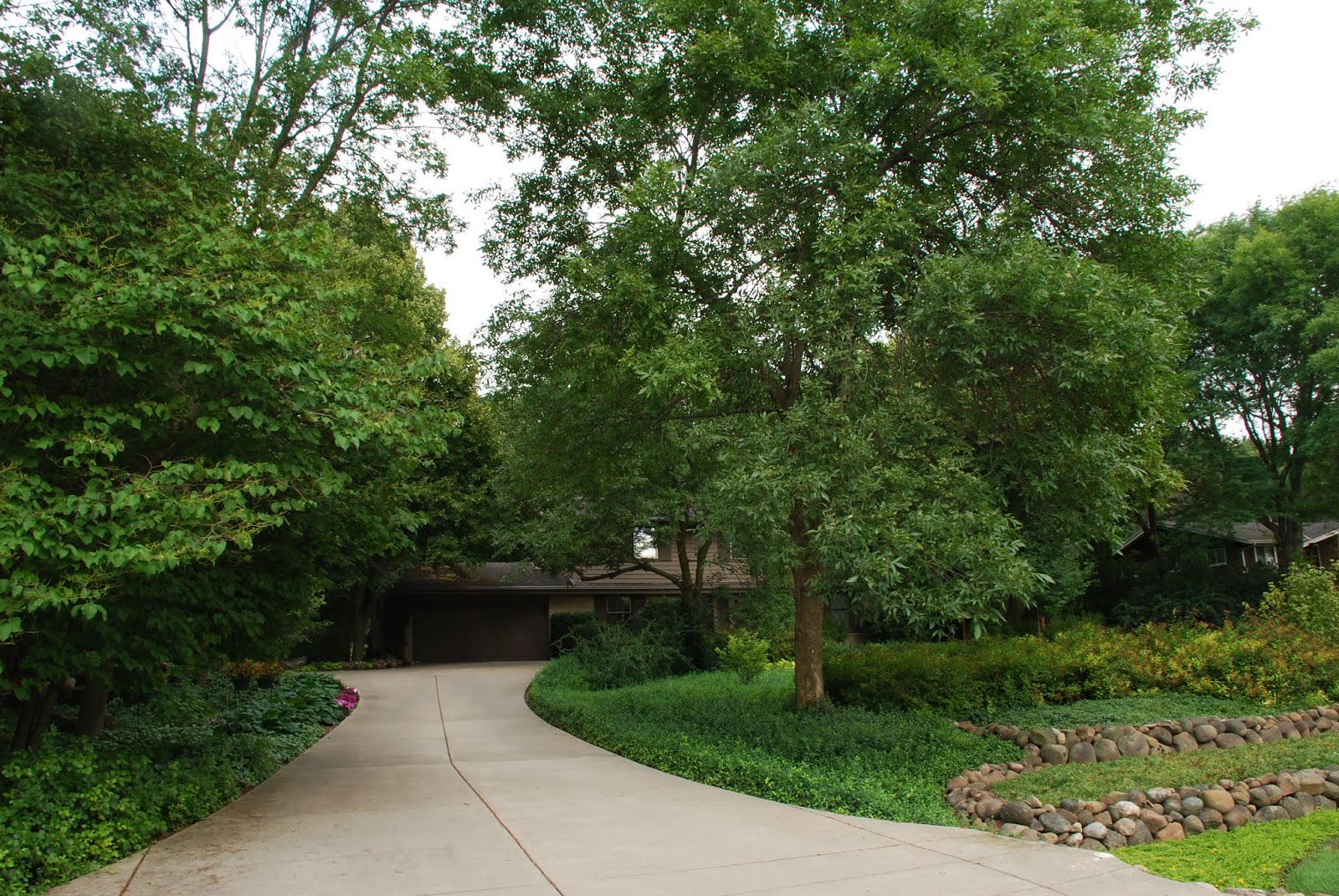
    The last post showed the Hedgerow Garden, which is on the south side of the front yard, between the drive and the south lot line.  These photos show the rest of the front yard, mainly from the other side of the drive to the north lot line.
   I no longer have impatiens in containers, as is shown in several photos--due mainly to downy mildew.
   Photos two and three show the bluestone sidewalk, installed in 1970, then extended twice as far as the back of the right side of the house.
   Photos four and five show the cactus and succulent garden on the north side of the property, just off the lawn.  All the plants are in containers placed amongst the rocks, and I overwinter them in my basement.  Photo six shows a bit of the cactus garden in the lower left, and this view looks toward the Hedgerow Garden beyond the drive.
   The last four photos show the turnaround part of the drive.  The stockade fence is on the south lot line.  It was installed about 30 years ago and will be replaced in the next few weeks.  The last photo shows the entry to the Sunken Garden, which the next post will show.


Friday, April 17, 2020

The Hedgerow Garden

   On the left side of the drive is what is called the Hedgerow Garden.  It is called that because this hedgerow separated two farm fields in this spot since the 1800s.  
   The hosta lining the drive is Potomac Pride, which has thick leaves and has never suffered any slug damage.  The perennial with maple-shaped leaves is Kirengeshoma palmata, or Yellow Waxbells.
   There are several moss gardens here, and some rocks have had moss attached to them with 100% silicone caulk to hold the moss in place until it forms its own attachment.  The moss in the round container in the last photo is called Anomodon rostatus.


Thursday, April 2, 2020

Taking a tour

     On the post of March 9th, I displayed some maps of my property.  Now, I will take you on a "tour" of the gardens.  This will take several posts over the next few months.  So, when reading those posts, go back to the post of March 9th to "follow me along" in the gardens.  The "tour" will go clockwise, with this first post being of the front of the property, with all photos taken from the street.
     Some of these photos were taken a few years ago, so a bit has changed.  The biggest change is the removal of a green ash just in front of the house.  And in a few weeks, the ash along the right side of the drive near the street will bite the dust.
     I built the fieldstone terraces in 2007, using nearly 2000 stones.  I got them from my neighbor's property across the street, making a tiny dent in the millions of stones in 700 feet of a fenceline built during pioneering days of the mid-1800s.  She was a widow, and she was happy to give them to me for free, as in exchange I let her view my yard everyday, the view of which she loved.
     The first plant in the ditch next to the lawn is Lysimachia nummularia (Moneywort).  The dark green planting in the triangular area is Muehlenbeckia axillaris (Wirevine).  The plant in the first terrace is Sedum floriferum 'Weihenstephaner Gold.'  The top layer is planted with Vinca minor.  The groundcover on the right side of the driveway is Euonymus fortunei 'Coloratus' (Purple Leaf Wintercreeper), which I mow with a lawnmower each spring to keep it from getting too high and coarse.