Contact Form

Name

Email *

Message *

Monday, February 13, 2017

A little explanation

     My wife, Dorothy, and I bought our one-acre property in 1969.  It is 150 feet wide and 300 feet deep, with a bit cut off on the back left.  We bought it mainly because there was a hill on it, and I knew that could make for more interesting landscape gardens.  Plus, it had a 20-acre woods behind.
     The first photo shows us, along with Dorothy's father, just before starting to build the house.  The next two photos show the house in 1970 and 1972.  Notice that the driveway does not go straight out to the road, as usual.  I curved the drive to the side of the lot for two reasons.  First, it would make for a wider lawn, making the lot appear wider.  Second, I thought the curved drive would make for a more pleasing entry.  After 47 years, my wife still is mad at me for doing that, as so many visitors have a hard time backing out.  Quite a few have driven off the pavement.  Too bad.
     The fieldstone terraces in the front were built in 2007.  I never liked the plain flat front lawn extending into the ditch.  A year earlier, I saw a photo of a very abstract design of a lawn somewhere in Europe.  It had three flat sections, rising at different rates, with the highest rising about 20 feet in total.  The most unusual thing is that they did the same thing in the opposite direction, but the three levels flipped (meaning that the fastest rising one became the slowest rising one).  Somehow, in trying to emulate it, I came up with the design of terrace levels with intersecting curves. Not the same, but a bit different, nevertheless.  My (ordinary) neighbor said I should have built an "ordinary" terrace.  I asked him, "Do I seem ordinary to you?"
     The plant at the base is Lysimachia nummularia (Moneywort).  The first terrace has Sedum floriferum 'Weihenstephaner gold' and the next terrace Vinca minor (Periwinkle).  The dark green plant in the center is Muelenbeckia axilaris (Wire Vine).


Monday, February 6, 2017

More winter green

     An especially cheerful and beautiful moss in the winter is Dicranum scoparium, commonly called broom moss, as its leaves are swept to the side, resembling a broom.  The first three photos show it, the last taken with a closeup macro lens.  I have yet to find this moss growing in SE Wisconsin, as it seems to prefer acidic substrates, and the ground around my home is slightly alkaline.  I collect this moss where it grows in central and northern Wisconsin.
     The last four photos are of my favorite moss, Anomodon rostratus.  Preferring alkaline conditions, I find it in many places in SE Wisconsin, from ground to limestone rocks to the bases of trees.  I often attach it to limestone rocks (sometimes granite rocks) with 100% silicone caulk for anchoring purposes.  If it "likes" the rock, it will put down rhizoids in a few months into the rock.  Then it spreads, as can be seen in the photos.  In these two cases, the moss have been attached for from six to eight months.  The last photo shows a rapidly extending stem


on a rock.

Monday, January 30, 2017

Winter green

     Well, seeing it won't snow much in January, I went looking for green in the garden last week.  And I found lots of it--in my mosses, delightfully growing with the rain and temperature in the 40s.
And when the sun came out, simply delightful!  Too bad I had to get to be 62 before I discovered their beauty.  I just read an article in The American Gardener (of the American Horticultural Society) on "plant blindness."  Coined in the 1990s by botanists, it means a tendency to ignore plants in one's surroundings, a "malady" suffered by a surprisingly large share of people, research shows.  I notice that when various workers, from cable staff to plumbers, walk in parts of my gardens and never notice anything out of the ordinary (or they don't mention it).  Then on garden tours I have trouble keeping my head from exploding (from the comments).  Anyhow, I had such blindness of mosses until I stumbled upon a single small moss garden in 2005.  Since then, I feel as a six-year old, ignorant of 20-200 vision for six years, must feel when first wearing glasses.
     The first three photos shows the west end of my Japanese-style garden, which has several mounds of moss and many moss-covered rocks.
     The next photo is of a 10-inch long piece of split bamboo with four species of moss, from left to right: Anomodon rostratus, Brachythecium salebrosum, Plagiomnium cuspidatum, and Hygroamblystegium varium.  The next two photos shows the larger and aggressive Brachythecium invading the Anomodon (in a couple of years, the Anomodon will be history without "weeding").  However, the B. salebrosum is actually rising up the ranks of my favorite mosses, and the second last photo shows it growing on a rock I found. 
     The last photo is of an incredible moss, as it changes from a dormant dry brown to a beautiful yellow green only five seconds after having water rehydrating its leaves.  Quite a sight to see.  It prefers growing on granite rocks in full to partial sun. 


Monday, January 23, 2017

More winter remembered

     The warm, gloomy weather continues here in Wisconsin.  So, here are a few more photos of last month's true winter weather.
     The first photo is of one of six railings I built last summer.  The faucet is next to the box that covers it while not in use.
     The plant is a 'P.J.M.' azalea, a broadleaf evergreen.  The waterfall might be running soon if the current "winter" holds...and birds will be drinking unfrozen water from the birdbath.
     Finally, the last two photos are of the sitting area next to the pergola that overlooks the back lawn.


Thursday, January 19, 2017

Winter remembered

     I say "remembered" because virtually all the 22 inches of December snow has melted, as Seattle-Portland weather has settled in.  Yuck!
     The first two photos are of a wooden structure I built last summer (shown in an earlier post).  I was inspired to build it after visiting Frank Lloyd Wright's Taliesen in Spring Green, Wisconsin.
     The next photo is of a granite cobblestone planter built in the 1980s.  Following are snow-covered black kettle pots for my begonias next to a Stephanandra planting.  The next photo is not a white cake, but a buried bird bath.
     There are two photos are of an 8-inch container of moss with a face on one side.  The leaves are of a Viburnum tomentosum var. plicatum.


Wednesday, January 11, 2017

Kyoto 6--Nijo Castle gardens and Entoku-in

     This is the final post of the gardens of Kyoto, Japan.  The first two photos are of the main garden in the ancient Nijo Castle, where the government of Japan was centered for hundreds of years until the mid-1800s, when Kyoto was known as Edo.  This garden is called the Ninomaru Garden.  It has a nice arrangement of pines on mounds with a pond in the foreground.  Under one of the pines is a moss garden, Polytrichum commune being the species used.  The second photo shows the problem with maintenance, as pine needles continually drop into the moss.  And it requires hand removal primarily, as the needles get stuck in the moss.
     Photos three and four show another castle garden, Seiyu.  Polytrichum is used here, as well, but the garden appears more formal, especially with the bamboo in the background.  Bamboo is not used in the gardens of Japan as much as I thought.  I like their appearance, and I rarely found them to appear to be thuggish (aggressive in their spreading by rhizomes) as is often stated as a problem.
     The last four photos were taken in the temple of Entoku-in.  The pleasant entry has moss on either side of a walkway, with Polytrichum mixed with several other genera.  The second last photo was taken from inside the temple.


 Entoku-in


Monday, January 2, 2017

Kyoto 5--Sanzen-in and Hosen-in

     These two gardens are in the northeast part of Kyoto, called Ohara.  The first four photos were taken in Sanzen-in.  The fourth photo was taken from inside the temple, showing an abundance of fallen leaves on the moss lawn.  Most gardens blow the leaves in the morning before opening, but not this one.
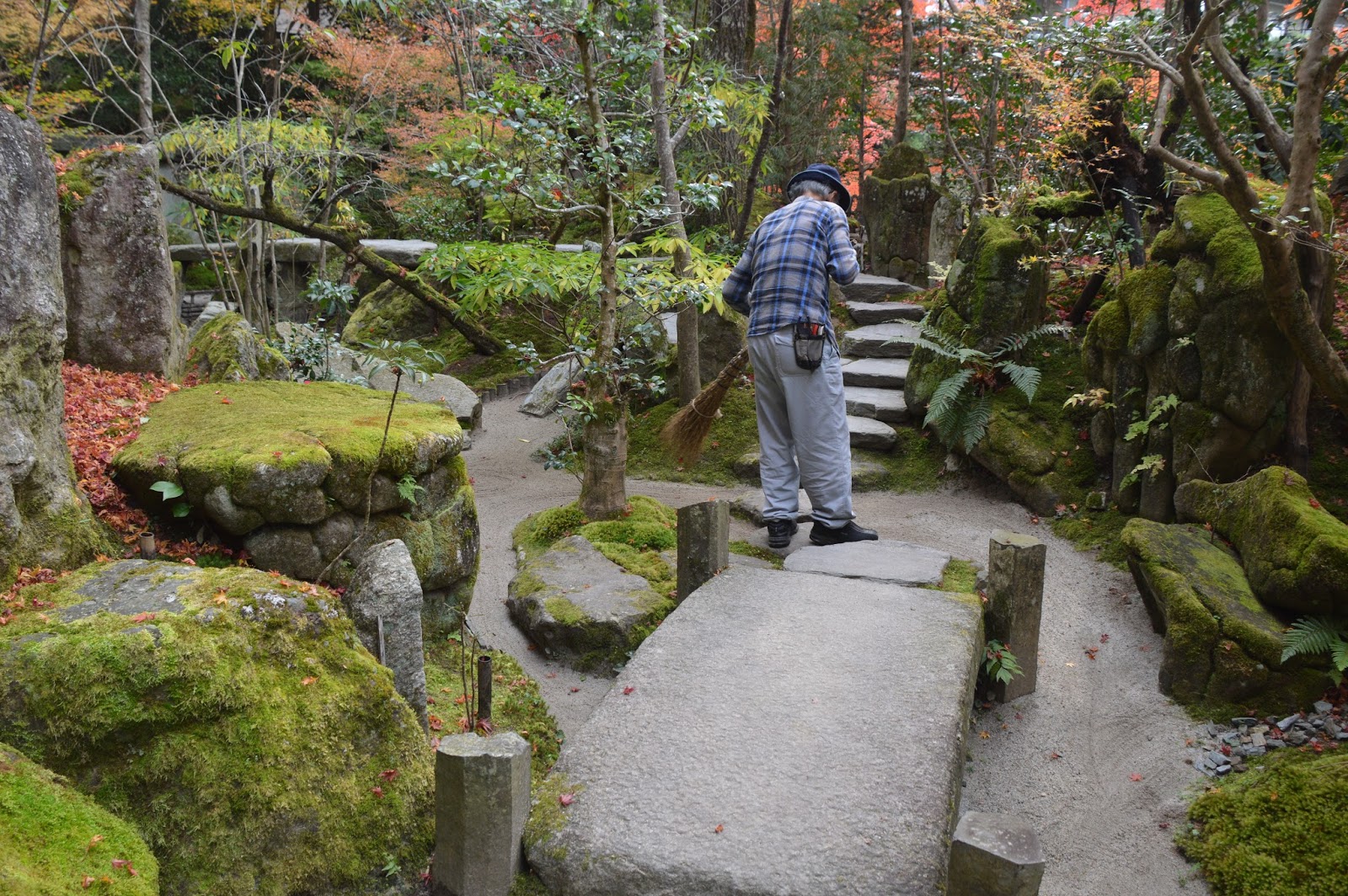
     The other photos were taken in nearby Hosen-in.  It was a more interesting garden than most because the terrain was uneven, with lots of steps and twisting paths.  Two photos show a gardener brushing the sand around several stones.  If gardens have such "dry seas," they almost invariably use gravel, making ridges that represent waves with rakes.  The last photo shows a large, 700-year-old pine tree.


 Hosen-in